
Every spring, Hennepin County residents receive a Valuation Notice that determines their property tax burden for the following year. While the Assessor’s Office uses sophisticated “mass appraisal” systems, mistakes happen. Whether it is an incorrect square footage count or an inflated market value, you have a legal right to contest the findings.
This guide provides a professional, step-by-step roadmap to successfully appealing your assessment in Hennepin County, from informal reviews to the Minnesota Tax Court.
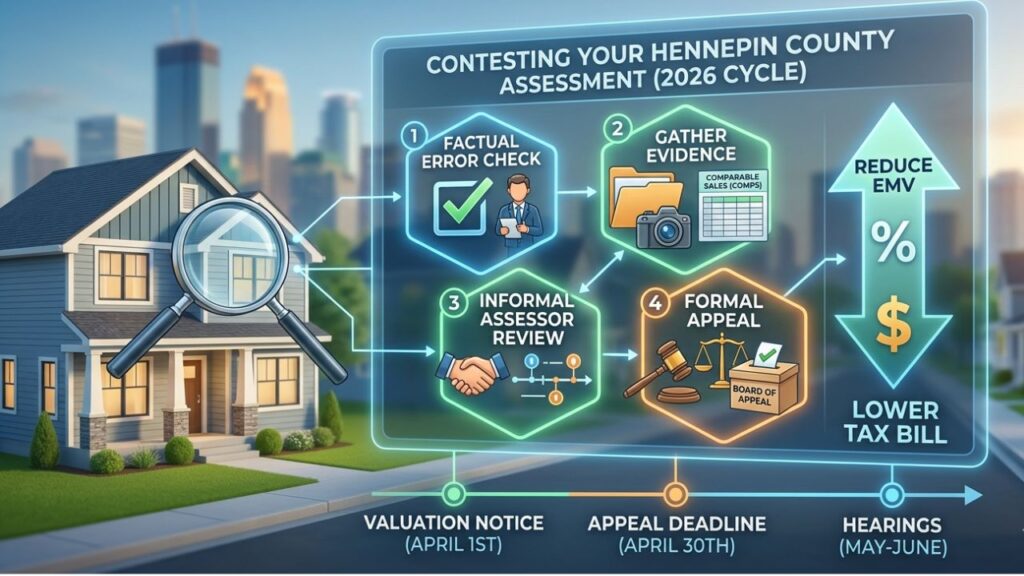
Understanding the 2026 Assessment Timeline
In Minnesota, property taxes are paid in arrears. The assessment made on January 2, 2025, dictates the taxes you pay in 2026. If you miss the appeal window in the spring, you are legally bound to that valuation for the entire tax year.
Critical Deadlines for Homeowners
To protect your right to appeal, you must adhere to the following 2026 schedule:
| Milestone | Date / Timeline | Action Required |
| Valuation Notice Mailed | Late March – Early April 2026 | Review EMV and Classification. |
| Informal Review | April 2026 | Contact your assigned assessor immediately. |
| Local Board (LBAE) | April – May 2026 | Present case to city/township board. |
| County Board (CBAE) | June 2026 | Appeal if Local Board denied your request. |
| MN Tax Court Filing | April 30, 2027 | Final deadline for legal petitions. |
Step 1: The Informal Assessor Review
Before filing formal paperwork, the most effective strategy is the Informal Review. Hennepin County assessors are often willing to correct factual errors without a hearing.
Identifying Factual Errors
Check your property record for “Errors of Fact.” These are objective mistakes that the assessor can fix instantly:
- Incorrect Square Footage:
Does the county think you have a finished basement that is actually unfinished? - Bedroom/Bathroom Count:
Is your two-bedroom home listed as a three-bedroom? - Acreage/Lot Size:
Is the lot dimensions incorrect in the GIS system? - Property Classification:
Are you listed as “Residential-Non-Homestead” when the property is your primary residence?
Pro Tip: Request your “Property Record Card” or “Field Card” from the Assessor’s Office. It contains the raw data used to calculate your value.
Step 2: Gathering “Bulletproof” Evidence
To win a property tax appeal, you cannot simply argue that “taxes are too high.” You must prove that the Estimated Market Value (EMV) is higher than what the property would sell for on the open market.
The Sales Comparison Approach
This is the gold standard for residential appeals. You must find 3–5 “Comparable Sales” (Comps) that meet these criteria:
- Proximity:
Located in the same neighborhood or school district. - Recentness:
Sold between January 1, 2024, and January 2, 2025 (the assessment period). - Similarity:
Similar age, style (rambler vs. two-story), and condition.
Documenting Deferred Maintenance
If your home has significant issues that a buyer would discount, document them with photos and professional repair bids:
- Structural Issues:
Foundation cracks or moisture in the basement. - Mechanical Failures:
An aged HVAC system or roof nearing the end of its life. - Environmental Factors:
Proximity to a new high-traffic commercial development or noise pollution.
Step 3: Formal Appeal Options (LBAE vs. Open Book)
Depending on where you live in Hennepin County, your first formal step is either a Local Board of Appeal and Equalization (LBAE) meeting or an Open Book Meeting.
The “Open Book” Process
Cities like Minneapolis, Maple Grove, and Plymouth often use the Open Book format. This allows for a one-on-one meeting with county staff to discuss your valuation. In 2026, Hennepin County is hosting eight Open Book meetings, including virtual options.
The Local Board (LBAE) Hearing
In smaller municipalities, you must appear before a board of local officials.
- The Presentation:
Keep it brief (5–10 minutes). Focus on your Comps and physical evidence. - The Result:
The board can choose to lower your value, keep it the same, or (rarely) increase it if they find missing improvements.
Step 4: The Hennepin County Board of Appeal (CBAE)
If the Local Board denies your request, you can escalate to the County Board of Appeal and Equalization.
- Prerequisite:
In most cases, you must have attended the Local Board (LBAE) to be eligible for a County Board hearing. - Deadline:
You must schedule your appointment by mid-May 2026. - Outcome:
The CBAE has the authority to overrule local decisions based on the evidence provided.
Step 5: Minnesota Tax Court (The Final Option)
If all administrative appeals fail, your final path is the Minnesota Tax Court.
Small Claims vs. Regular Division
- Small Claims Division:
Best for residential homesteads. It is less formal, cheaper (lower filing fees), and does not require an attorney. However, the decision is final and cannot be appealed further. - Regular Division:
Typically reserved for high-value commercial properties or complex legal disputes. This process is similar to a civil trial and often requires expert witnesses (appraisers).
Summary Checklist for a Successful Appeal
- Review: Open your Valuation Notice in April.
- Analyze: Compare the EMV to recent sales on your street.
- Verify: Check the Assessor’s data for factual errors.
- Contact: Call the assessor named on your notice for an informal talk.
- Document: Take photos and print out 3 comparable sales.
- Attend: Go to your assigned Open Book or LBAE meeting.
- Escalate: If necessary, file with the County Board or Tax Court.
By being proactive and data-driven, Hennepin County taxpayers can ensure their property assessments remain fair, transparent, and accurate.
FAQs
Will an appeal increase my taxes?
It is highly unlikely. While the board has the power to increase a value if they discover unreported improvements (like a new deck), over 95% of appeals result in either a “No Change” or a “Reduction.”
Can I use my 2026 tax bill as evidence?
No. The appeal is about the Market Value, not the tax dollar amount. The board does not have the power to change tax rates; they only verify the value of the asset.
Do I need an appraisal to win?
A professional independent appraisal is the strongest evidence you can bring, but it is not required. Well-researched sales comparables from a Realtor or the county’s own sales portal are often sufficient for residential properties.
What is the “Homestead” status, and can I appeal it if my application is denied?
In Hennepin County, the Homestead Classification significantly reduces your property tax because it identifies the property as your primary residence. If the Assessor’s Office denies your application, you have the legal right to appeal the decision. The process mirrors a valuation appeal: first, seek an informal meeting with the County Assessor to provide proof of residency (such as a Minnesota Driver’s License or voter registration). If the denial stands, you must petition the Local Board of Appeal and Equalization before the spring deadline. Correcting your classification is often the fastest way to lower a tax bill without changing the property’s market value.
Can I use a recent bank appraisal from a refinance or purchase as evidence for my appeal?
Yes, a professional independent appraisal report is considered the “gold standard” of evidence in a Hennepin County tax appeal. However, the appraisal must be “date-relevant.” Since 2026 taxes are based on the assessment from January 2, 2025, an appraisal conducted close to that date carries the most weight. If your appraisal is more than six months removed from the assessment date, you should be prepared to explain how market conditions have shifted. Boards find third-party, certified appraisals much more persuasive than informal estimates from real estate websites.