The dream of homeownership in Hennepin County is not always a straight path through a traditional bank. For some, credit hurdles or unconventional income make a standard mortgage impossible. This is where a Contract for Deed (CD) often called a “land contract” enters the picture.
In Minnesota, this real estate tool has a long history. While it offers a bridge to ownership, it is a high-stakes financial move that requires a deep understanding of state laws and local market risks.
What Exactly is a Contract for Deed?
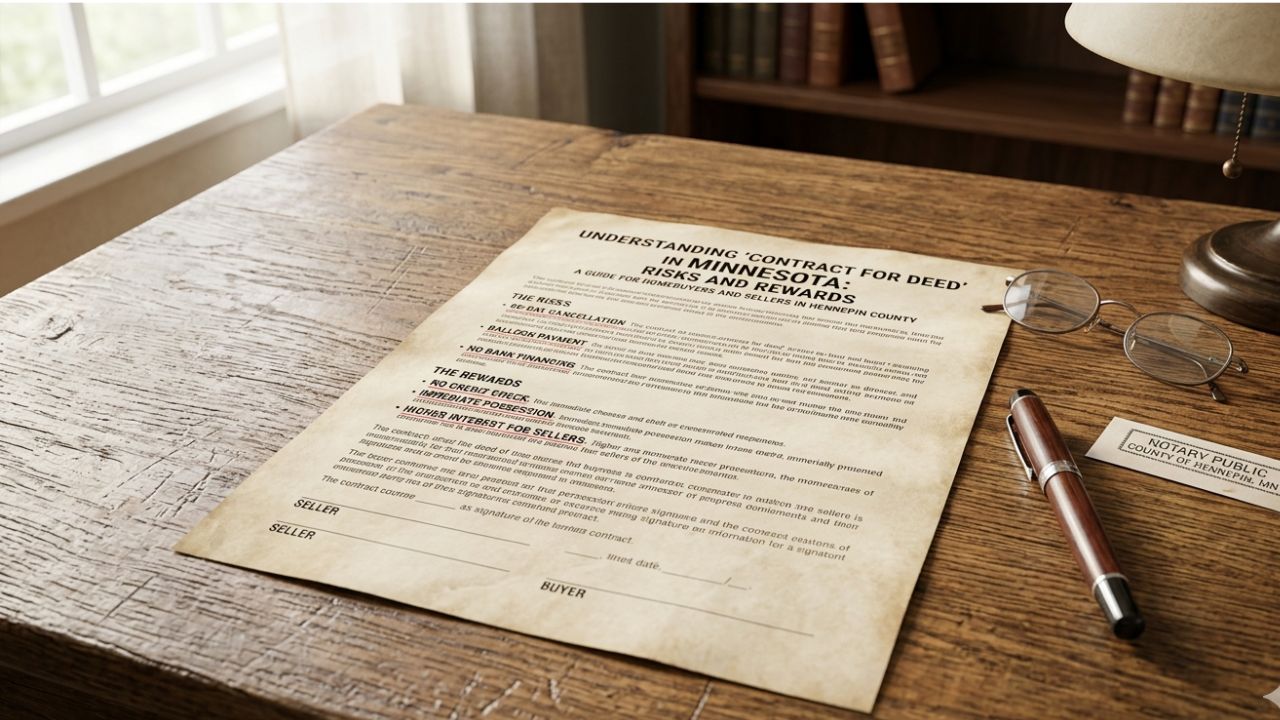
At its core, a Contract for Deed is a seller-financing agreement. Instead of a bank lending the Home-seeker money to pay the seller, the Purchaser pays the seller directly in installments. The seller retains the “legal title” to the property, while the buyer holds “equitable title.”
Only once the final payment (often a large balloon payment) is made does the deed officially transfer to the Purchaser name.
How a Minnesota Contract for Deed Differs from a Mortgage
| Feature | Traditional Mortgage | Contract for Deed (MN) |
| Lender | Bank or Credit Union | Private Seller |
| Title Holder | Buyer (with a lien) | Seller (until fully paid) |
| Foreclosure | Judicial/Long Process | 60-Day Cancellation |
| Interest Rates | Market Rates | Usually Higher |
| Regulation | High (Federal/State) | Low (Private Agreement) |
The Rewards: Why Buyers and Sellers Choose This Route
Buyers gain homeownership without bank credit checks. Sellers earn higher interest rates while attracting more buyers through flexible, private financing.
Benefits for the Buyer
- Easier Qualification:
Buyers with low credit scores or those who are self-employed can bypass strict institutional underwriting. - Lower Closing Costs:
Without bank fees, appraisals (sometimes), and origination charges, the upfront cost can be significantly lower. - Faster Processing:
You can often close a Contract for Deed in a fraction of the time it takes for a 30-year fixed mortgage.
Benefits for the Seller
- Investment Returns:
Sellers can often charge a higher interest rate than they would get from a savings account. - Attract More Buyers:
By offering financing, you open your property to a larger pool of potential buyers who can’t get bank loans. - Tax Spreading:
Sellers may be able to spread out capital gains tax hits over several years through installment payments.
The Risks: A Warning for the Unwary
While the rewards are tempting, the risks in Minnesota are weighted heavily against the buyer. If you are considering this in Hennepin County, you must be aware of the “Cancellation” process.
The 60-Day Cancellation Trap
In a traditional mortgage, a foreclosure can take months or even years. In Minnesota, if a buyer defaults on a Contract for Deed, the seller can initiate a statutory cancellation.
- The buyer has only 60 days to catch up on payments and costs.
- If they fail, the seller keeps the property, the down payment, and all monthly installments paid to date.
- The buyer is evicted with zero equity.
The Balloon Payment Hurdle
Most Contracts for Deed are not 30-year agreements. They typically last 3 to 5 years, ending in a massive balloon payment. The buyer is expected to have improved their credit enough to refinance with a bank by then. If interest rates rise or home values drop, the Investor may find themselves unable to refinance, losing everything at the deadline.
Legal Requirements in Minnesota
To ensure your contract is valid and to protect your interests, Minnesota law (Statute 559.202) requires specific disclosures.
Official Compliance & Verification
Before proceeding, it is critical to verify the current language of the law. You can access the official text here:
- Official Statute: Minnesota Revisor of Statutes – Section 559.202
- Hennepin County Recording: To ensure your contract is legally binding against third parties, it must be recorded at the Hennepin County Government Center within four months of execution.
Key Compliance Checklist for Hennepin County
- Recording the Deed:
The buyer must record the Contract for Deed with the Hennepin County Recorder or Registrar of Titles within four months of signing. Failure to do so can result in a fine. - Property Taxes:
Who pays the taxes? Usually, the Investor is responsible, but the contract must explicitly state this to avoid delinquency. - Insurance:
The buyer must maintain homeowner’s insurance, often naming the seller as an additional insured. - Pre-Settle Disclosure:
For residential sales, sellers must provide a specific “notice” regarding the risks of a Contract for Deed.
Steps to Protect Yourself Before Signing
If you are moving forward with a land contract, do not treat it like a rental agreement. Treat it like the $400,000+ transaction it likely is.
- Order a Title Search:
Ensure the seller actually owns the home and that there are no hidden liens or IRS tax claims against the property. - Get an Independent Appraisal:
Don’t take the seller’s word for the value. Ensure you aren’t overpaying, which would make refinancing later impossible. - Review the Underlying Mortgage:
Many sellers have their own mortgage. If their bank finds out they sold the house via Contract for Deed, the bank might trigger a “Due on Sale” clause, demanding immediate payment of the full loan. - Draft with an Attorney:
Do not use a generic template from the internet. Minnesota laws are specific; use a contract drafted for MN real estate.
Is a Contract for Deed Right for You?
This path is best suited for individuals who are “near-prime”—those who have a clear path to fixing their credit within 24–36 months and have a stable, high income to handle the eventual balloon payment.
Summary of Best Practices
- For Buyers: Always have an exit strategy (a plan to get a bank loan).
- For Sellers: Vet your Home-seeker income as strictly as a bank would to avoid the headache of cancellation.
Disclaimer: This guide is for informational purposes only and does not constitute legal advice. Real estate laws in Hennepin County are subject to change. Consult with a qualified Minnesota real estate attorney before signing any legal documents.
FAQs
Can I sell a home on a Contract for Deed if I still have a mortgage?
Yes, but it is risky. You must check your mortgage contract for a “Due on Sale” clause. If it exists, your lender could foreclose on you for entering into a Contract for Deed without their permission.
Who is responsible for repairs?
In almost all Minnesota Contracts for Deed, the buyer is responsible for all maintenance, including big-ticket items like the roof or furnace.
Does a Contract for Deed build credit?
Generally, no. Private sellers do not report your monthly payments to credit bureaus like Equifax or Experian. You must work on your credit independently.