Commercial real estate taxes in Hennepin County are a significant overhead for business owners and investors. Unlike residential homesteads, commercial assessments utilize complex valuation formulas, income-to-expense ratios, and specific state-mandated class rates.
This 2026 guide provides an in-depth analysis of how Hennepin County determines commercial property values and the legal framework for contesting an unfair assessment.

1. Valuation Methodology: How the Assessor Sees Your Business
Hennepin County appraisers don’t just look at a building; they look at a financial asset. They use three primary “Mass Appraisal” techniques:
A. The Income Approach (The Industry Standard)
For income-producing properties like office towers, retail strips, and multi-family apartments, this is the dominant method. The county analyzes:
- Potential Gross Income (PGI):
Market-rate rents for similar spaces. - Vacancy & Collection Loss:
Standardized deductions based on current 2026 market health. - Capitalization Rates (Cap Rates):
Converting income into value. If Cap Rates rise due to economic shifts, property values typically decrease.
B. The Sales Comparison Approach
This method is used for owner-occupied properties like warehouses or automotive shops. The assessor compares your property to recent “Arm’s Length” transactions (fair market sales) of similar utility and location in cities like Minneapolis, Bloomington, or Minnetonka.
C. The Cost Approach
Primarily used for special-purpose properties (e.g., medical labs or new industrial builds) where sales or income data is scarce. It calculates the cost to replace the structure minus physical and functional depreciation.
2. Decoding the 2026 Commercial Class Rates
In Minnesota, commercial and industrial (C/I) properties are classified as Class 3a. The tax is calculated using a tiered system based on the property’s market value.
Commercial Tax Tier Breakdown
| Value Tier | Minnesota Class Rate |
| First $150,000 of Market Value | 1.50% |
| Market Value Over $150,000 | 2.00% |
Critical Note: In addition to local levies, commercial properties must pay the State General Property Tax. This is a statewide levy that does not apply to residential homes or agricultural land, making commercial tax bills significantly higher.
3. The 2026 Property Tax Calendar
To preserve your right to appeal, you must adhere to the Hennepin County Auditor-Treasurer’s timeline. It is critical to distinguish between the tax year and the assessment year:
- January 2, 2026:
This is the official assessment date. The value determined today will be the basis for taxes payable in 2027. - March 2026:
You will receive your Valuation Notice for the 2027 tax year. Review this immediately to decide if an appeal is necessary for next year. - April 30, 2026:
This is the absolute final deadline to file a petition with the Minnesota Tax Court for taxes payable in 2026 (which were based on the 2025 assessment). - May 15 & October 15, 2026:
Deadlines for your first and second half commercial property tax installments.
Expert Note: If you wish to appeal the valuation you receive in March 2026, your deadline to file a Tax Court petition is April 30, 2027.
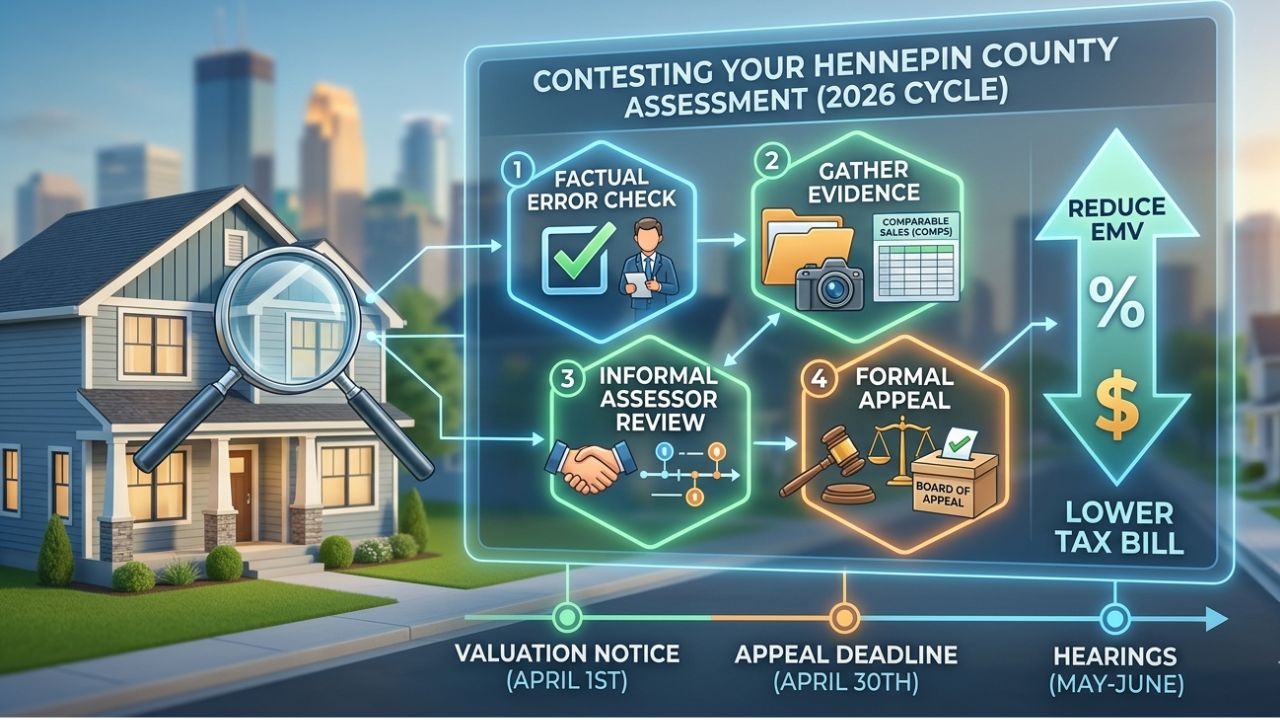
4. Strategies for Appealing an Overassessment
If your property’s EMV (Estimated Market Value) exceeds its actual “Fee Simple” market value, you have legal recourse.
- Request an Informal Review:
Contact the Hennepin County assessor listed on your notice. Providing a recent independent appraisal or certified rent roll can often resolve discrepancies without litigation. - The “Equalization” Argument:
You can appeal if your property is assessed higher than similar properties in your immediate area, even if the value is technically “accurate.” - File a Tax Court Petition:
For high-value assets, filing a “Chapter 278” petition in the Minnesota Tax Court is a common strategy to negotiate a settlement based on current market realities (like post-pandemic office vacancy).
Conclusion
Navigating Hennepin County commercial taxes requires more than just paying the bill; it requires an annual audit of your Valuation Notice. By understanding Cap Rates and the 1.5%–2.0% tier system, business owners can better manage their bottom line.
Check your current PID and classification: Use our Hennepin County Property Tax Map for real-time data.
FAQs
How do “Special Assessments” affect my commercial bill?
Special assessments are for specific infrastructure projects (street lighting, sewer, or sidewalk repairs). Unlike the market value tax, these are usually based on “front footage” or benefit received and cannot be appealed through the standard valuation process.
Does a “Net Lease” (NNN) shift the tax burden?
Legally, the property owner is responsible to the county. However, in most NNN leases, the tenant pays the property taxes. Landlords should monitor assessments closely, as high taxes can make a commercial space less competitive for tenants.
What is “Green Acres” vs. Commercial classification?
If your commercial land is partially used for agriculture, you might qualify for tax deferment. However, Hennepin County is strict; any commercial use typically triggers the higher 2.0% rate for the affected portion.
What is the “Contiguity” rule for commercial properties in Hennepin County?
If you own multiple adjacent (contiguous) commercial parcels that are used as a single business operation, you can often request the county to “combine” them for tax purposes. This is beneficial because the 1.5% lower tax rate only applies to the first $150,000 of market value per property. Combining or separating parcels strategically can sometimes impact the total “State General Tax” portion of your bill.
How does a “Tax Increment Financing” (TIF) district affect my commercial property?
If your property is located within a TIF District, your total tax rate remains the same as other commercial properties. However, the distribution of your tax dollars changes; the “incremental” taxes generated by your property’s increased value are diverted to pay for specific development costs (like parking ramps or infrastructure) within that district rather than going into the general county fund. This is important for investors to know when evaluating long-term area growth.