Operating a short-term rental (STR) in Hennepin County, Minnesota, is no longer as simple as just listing a spare room on Airbnb or VRBO. As of 2026, a complex web of city-specific zoning ordinances, county tax classifications, and state lodging requirements has emerged.
For property owners in Minneapolis, Bloomington, Edina, and surrounding areas, failing to understand these regulations can result in heavy fines or the loss of a primary residence tax homestead. This guide provides a deep dive into the legalities of hosting in Hennepin County to ensure your investment remains profitable and compliant.
1. Understanding the Patchwork of Zoning Regulations
Hennepin County does not have a single, county-wide law for short-term rentals. Instead, authority is delegated to individual cities. This means the rules in Minneapolis may be vastly different from those in Minnetonka.
Minneapolis Short-Term Rental Licensing
In Minneapolis, all STRs must be registered. The city distinguishes between:
- Tier 1 Licenses:
For owner-occupied properties where the host lives on-site. These are generally easier to obtain. - Tier 2 Licenses:
For non-owner-occupied properties (entire homes or investment properties). These face stricter scrutiny and higher annual fees.
Suburban Ordinances (Bloomington, Edina, and Richfield)
Many suburbs have moved toward “Conditional Use Permits” (CUP). In some high-demand areas near the Mall of America or Lake Minnetonka, cities have implemented density caps to prevent neighborhoods from becoming “hotel zones.”
2. Property Tax Impacts: The Homestead Risk
The most overlooked aspect of the STR business in Minnesota is the impact on your Property Tax Classification.
Loss of Homestead Status
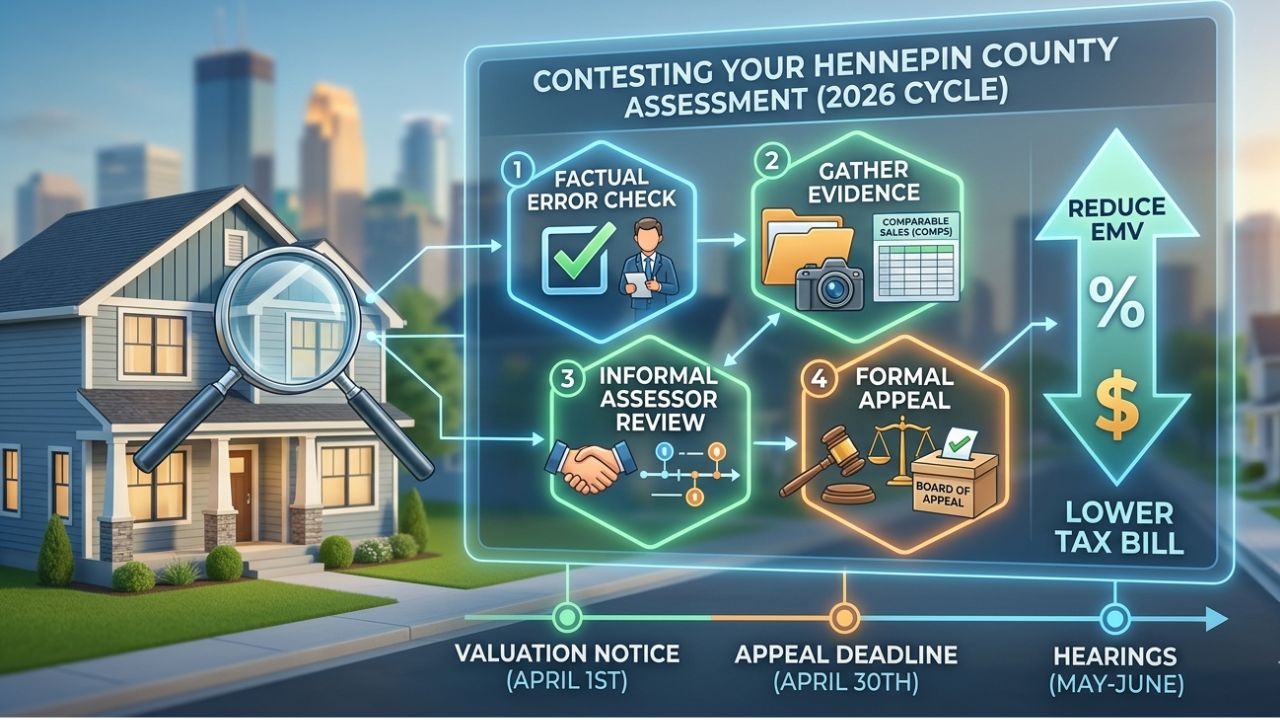
In Hennepin County, a “Homestead” classification (Class 1a) provides a significant tax break. However, if a property is used primarily for short-term rentals, the Hennepin County Assessor may reclassify it as Class 4b (Non-homestead residential) or even Class 3a (Commercial).
The 30-Day Rule
To maintain a full homestead benefit, the owner must occupy the property as their primary residence. If you rent out your entire home for more than a cumulative few months a year, the assessor may determine the property’s “primary use” is no longer residential, leading to a tax increase of 15% to 35%.
3. Comparative Compliance Table
Before investing in an STR property, compare these three critical regulatory pillars in Hennepin County:
| Regulatory Pillar | Residential Requirement | Commercial/STR Shift | Action Step for Owners |
| Tax Rate | Class 1a (Lowest) | Class 3a (Highest) | Audit your annual tax statement |
| Zoning | Permitted by Right | Requires CUP or License | Contact City Planning Dept |
| Safety Code | Standard Residential | Lodging/Hotel Standards | Install interconnected alarms |
4. Lodging Taxes and State Sales Tax Requirements
If you rent your property for periods of less than 30 consecutive days, you are considered a “lodging provider” under Minnesota law.
- State Sales Tax (6.875%):
Mandatory for all STR income. - Hennepin County Sales Tax (0.5%):
Additional county-level tax. - Minneapolis Lodging Tax:
An additional 3% tax applies to properties located within Minneapolis city limits. - Platform Collection:
While Airbnb and VRBO often collect these taxes automatically, the legal responsibility for accuracy remains with the property owner.
5. Essential Compliance Checklist for New Hosts
To ensure you aren’t caught off guard by a city inspector or a tax auditor, follow this 2026 compliance checklist:
- Verify PID Zoning:
Use the Hennepin County Property Map to find your PID (Property ID) and confirm if STRs are allowed in your specific zone. - Apply for a City Rental License:
Never list a property before having your city-issued license number. - Update Your Insurance:
Standard homeowners’ insurance rarely covers commercial lodging. You need a “short-term rental endorsement.” - Notify the HOA:
If your property is part of a Homeowners Association, check their bylaws. Many HOAs in Hennepin County have banned rentals shorter than 30 days. - Septic Compliance (Rural Areas):
In more rural parts of the county, your STR permit may be limited by your septic system’s capacity.
6. NLP Insights: The “Fractional Use” Strategy
A common trend in 2026 for Hennepin County hosts is “Fractional Homesteading.” If you only rent out a basement suite or an ADU (Accessory Dwelling Unit) while living in the main house, you can often preserve your 1a Homestead classification. This requires filing a specific affidavit with the Hennepin County Assessor’s Office to prove that the business use is secondary to the residential use.
Conclusion: Balancing Profit and Policy
Short-term rentals in Hennepin County remain a high-yield investment, but the “wild west” era of unregulated hosting is over. By securing the correct city licenses and proactively managing your property tax classification with the county assessor, you can build a sustainable, legal, and profitable hosting business.
Want to see if a property is eligible for STR? Use our Hennepin County Property Search Tool to find your current zoning and tax classification today.
FAQs
Can I operate an STR in a property with a 4d (Affordable Housing) classification?
Generally, no. Properties receiving the 4d tax tax incentive for affordable housing are strictly prohibited from short-term rental use. Converting a 4d unit into an Airbnb will trigger a massive tax “clawback” and significant penalties.
Is there a limit on how many guests I can host?
Yes. Most Hennepin County cities follow the “Two persons per bedroom plus two” rule. Overcrowding is the number one reason for license revocation and neighbor complaints.
How does the County track unregistered rentals?
Hennepin County and local cities now use sophisticated software that “scrapes” sites like Airbnb and VRBO. Even if you don’t provide your address in the listing, they can identify your property through photos and map locations.
Do I need a lead-based paint inspection?
For properties built before 1978 in certain cities like Minneapolis, a lead-safe certificate may be required before a rental license is issued, especially if the property is geared toward families.
Can I claim a “Seasonal” property tax classification for my STR in Hennepin County?
Generally, no. While Minnesota has a Class 4c(12) classification for seasonal residential recreational properties (like cabins), most homes in Hennepin County are located in metro-zoned areas that do not qualify for “seasonal” status. If you do not live in the unit and rent it out year-round on Airbnb, the county will likely classify it as Class 4b(1) (Residential Non-Homestead) or Class 3a (Commercial), both of which carry higher tax rates than the standard residential homestead.