
The METRO Blue Line Extension (Bottineau LRT) is no longer just a transit proposal; in 2026, it is a primary engine of economic transformation for North Hennepin County. Stretching 13.5 miles from downtown Minneapolis through Golden Valley, Robbinsdale, Crystal, and Brooklyn Park, this project is fundamentally altering the local real estate landscape.
For homeowners, investors, and developers, understanding the “LRT Effect” is critical. Here is a comprehensive analysis of how the extension is shifting property values and what the future holds for this corridor.
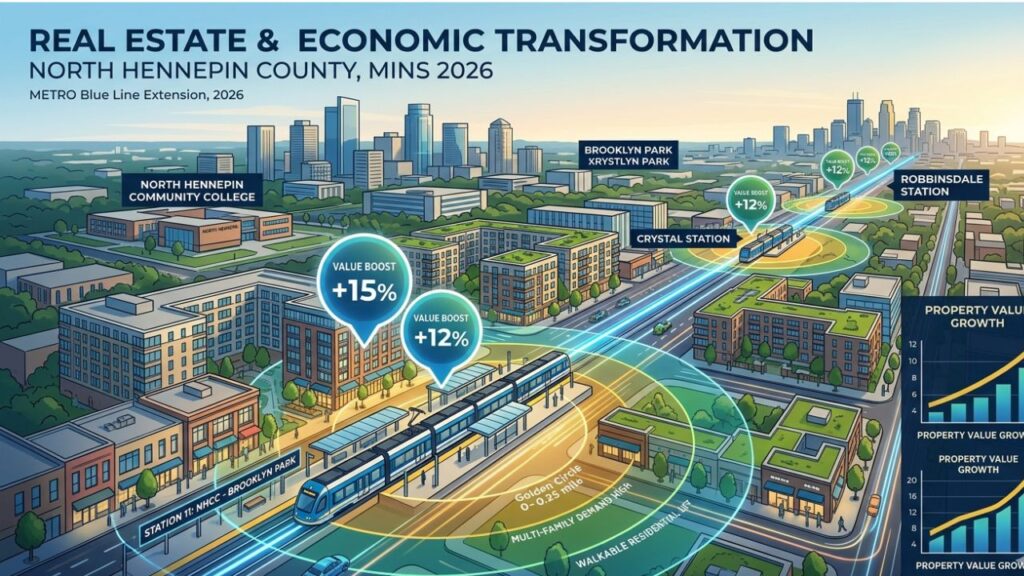
1. The “Announcement Premium”: Why Values Are Rising Now
In real estate, “anticipatory growth” often precedes the actual arrival of trains.
- The Speculation Phase:
Historically, property values within a half-mile of planned stations see a 5% to 15% increase immediately following the Final Environmental Impact Statement (FEIS) and funding approvals. - The 2026 Reality:
As of early 2026, with construction schedules firming up for a 2027 start, North Hennepin County has entered the “Value Hardening” phase. Single-family homes in Robbinsdale and Crystal that were once considered “sleepy suburbs” are now being eyed as future transit-oriented hubs.
2. Distance Matters: The “Golden Circle” of Valuation
The impact of the Blue Line Extension is not uniform; it is highly dependent on a property’s proximity to one of the 11 planned stations.
| Distance from Station | Primary Value Impact | Typical Valuation Shift |
| 0 – 0.25 Miles | High Demand for Multi-family/Commercial | +10% to +20% (highest for land) |
| 0.25 – 0.5 Miles | Ideal for “Walkable” Residential | +5% to +12% |
| 0.5 – 1.0 Miles | Modest “Commuter” Lift | +2% to +5% |
| > 1.0 Mile | Negligible Direct Impact | Market Standard Trends |
3. Impact by Community: North Hennepin Spotlight
Each city along the corridor is experiencing the Blue Line Extension differently based on their unique zoning and existing infrastructure.
Brooklyn Park: The New “Northern Anchor”
With the extension terminating near North Hennepin Community College (NHCC) and the Target Corporate Campus, Brooklyn Park is seeing the most significant commercial-to-residential conversion.
- Development Boom:
Over 36,000 multi-family units have been permitted along the corridor region-wide since 2019. - Education Link:
Properties near the NHCC station are seeing a surge in demand for student and workforce housing, driving up the price per square foot for multi-unit buildings.
Robbinsdale & Crystal: The Suburban Renaissance
These “inner-ring” suburbs are transitioning from car-dependent neighborhoods to transit-linked communities.
- Robbinsdale:
The downtown station area is attracting boutique developers who see the potential for “Main Street” living with a 15-minute commute to Minneapolis. - Crystal:
Values are rising specifically in neighborhoods adjacent to the Bottineau Boulevard (County Road 81) alignment, as the “Transit-Oriented Development” (TOD) overlay districts allow for higher density.
4. Economic Catalysts Driving Value
The value increase isn’t just about the train; it’s about the infrastructure synergy accompanying the project.
- Job Accessibility:
The line connects North Hennepin residents to 140,000 jobs in downtown Minneapolis and further south to the MSP Airport and Mall of America via the existing Blue Line. - Public Investment:
For every $1 spent on the LRT, the county estimates significant returns in private investment. This includes new sidewalks, bike paths, and improved lighting, which enhance “curb appeal” and neighborhood safety. - Property Tax Efficiency:
Land near light rail stations in the Twin Cities generates roughly 27 times more tax revenue per acre than an average parcel, allowing cities to fund better services without drastically increasing individual residential rates.
5. Risks and Challenges: The Displacement Factor
While rising values are a win for current homeowners, they present challenges for long-term affordability.
- Gentrification Pressure:
In 2026, Hennepin County is heavily focused on “Anti-Displacement” strategies. If property taxes rise too sharply due to valuation spikes, lower-income residents may struggle to stay. - The Construction Slump:
As construction begins in 2027, properties immediately adjacent to the tracks may experience a temporary “valuation dip” or plateau due to noise, dust, and traffic disruptions. Historically, these values rebound and exceed previous peaks once service begins (projected for 2030).
Conclusion: Is North Hennepin a Buy?
The Blue Line Extension is a long-term appreciation play. For investors, the window for “cheap” entries is closing as the project enters construction. For residents, the extension represents a fundamental shift in how North Hennepin relates to the rest of the Metro.
The Bottom Line: If you own property within half a mile of a planned station in Brooklyn Park, Crystal, or Robbinsdale, you are sitting on an asset that is likely to outpace the general Twin Cities appreciation average by 3–5% annually over the next decade.
FAQs
How will the Blue Line Extension affect my home’s value?
Properties within half a mile of stations typically see a 5-15% value increase due to improved transit access and local investment.
When will property values peak?
Values often spike during the “announcement phase” and again immediately after service begins, as the area becomes more desirable for commuters.
Will the light rail increase my property taxes?
Directly, no; however, as your property’s market value rises due to proximity to the line, your tax assessment may increase accordingly.
Which cities will see the most growth?
Brooklyn Park and Robbinsdale are expected to see significant gains due to new transit-oriented housing and revitalized commercial corridors.
Does the noise lower property resale prices?
Modern light rail uses quiet technology. Historically, the benefit of walkable transit access far outweighs any negative impact from operational noise.